Author: Jamie Elkon

  • One of those F*%$ing days!

    Dear Diary

    Today was just one of those F*&%ing days.

    It started with my beautiful limpet like daughter bashing on the bathroom door  shouting “Dadda! Dadda!” while I was trying unsuccessfully to move my now chronically paralyzed bowels (probably a bit too much information but there you go). My morning bathroom routine used to be one of the last shrinking bastions of independent space, no longer. Last week she managed to maneuver herself into the bathroom while I was on the loo and demanded to sit on my lap, my wife found us like that, she thought it was amusing, I didn’t. But anyway I digress, the point is that there I was, trying to immerse myself in a frightening article I was reading

    http://dailymaverick.co.za/article/2013-01-30-a-new-south-african-syndrome-scandal-fatigue ,which highlighted the egregious devil may care attitude of certain corrupt officials of the ruling party while they gorge themselves at the trough. In hindsight no wonder I am constipated.

    The wailing outside the door grew impossibly loud and as I glanced at my watch I realized that I was horribly late for work. The next half an hour deteriorated into bedlam culminating in my leaving home in an extremely agitated, irritable state. I still had to get my ten year old daughter to school and while I attempted to not let my irritation show while she prattled on, I almost drove straight into the back of a very large middle aged man wearing spandex (plumbers crack et al) as he weaved uphill in the middle of the road. I gave an irritated little hoot, he gave me a stubby finger and a litany of expletives which broadened my daughter’s rapidly expanding lexicon… for a very brief moment a spectacularly vivid murderous phantasy flashed through my mind but thankfully my sometimes shaky prefrontal cortex although barely online was able to regulate my powerful primordial impulse.

    What was interesting to note as the day continued to disintegrate (I’ll spare you the quite exasperating details) was that I began to observe my mind as an interested observer. I watched it with great curiosity as it began to mutter and gnash its teeth. I saw my mind swell as it inhaled judgements, anger and fear with alarming, allergic intensity. Each incident, each perceived sleight gave my mind more fuel to wage war on itself. At some point of  the day, after watching numerous reruns of the same repetitive, negative cognitive loops,  I managed to transition fully into the Observer after becoming quite bored with my mind’s histrionics after using a combination of CBT and mindfulness based strategies which have historically been very effective in bringing my runaway mind to heel. In order to further detach from the drama my inflamed mind had created throughout the day, I had to shift my awareness into a kinetic pursuit i.e. exercise (in the absence of my yoga mat or surfboard I walked… a lot). Furthermore, when my mind and body were quite weary from the drama I had put them through, I decided to immerse myself in an alternate reality by watching some escapist schmaltz when my family were asleep.

    And finally Dear Dreary Day Diary, I drag myself to you, as my confessor in an effort to unburden myself  from the mindless drama I sometimes create.

    Now, let’s see what my dreams will do with this day.

  • Rest the weary mind…

    Rest the weary mind…

    An old favourite…(press the sound clip 01 below)


    01 Rest in Natural Great Peace

    Rest in Natural Great Peace


    Rest in natural great peace
    This exhausted mind
    Beaten helpless by karma and neurotic thought
    Like the relentless fury of the pounding waves
    In the infinite ocean of samsara.

    Rest in natural great peace.
    Nyoshul Khenpo Rinpoche


  • Before I die…

    I’ve been thinking a lot about what is important, about my priorities, or lack thereof. The following article is from the Guardian (July 2012), it did its internet rounds and disappeared a couple of months ago. I stumbled upon it after watching the TED talk on a similar subject and thought it was worth resurrecting (apologies for the pun)…
    A palliative nurse has recorded the top five regrets of the dying.

    There was no mention of more sex or bungee jumps. A palliative nurse who has counselled the dying in their last days has revealed the most common regrets we have at the end of our lives. And among the top, from men in particular, is ‘I wish I hadn’t worked so hard’.

    Bronnie Ware is an Australian nurse who spent several years working in palliative care, caring for patients in the last 12 weeks of their lives. She recorded their dying epiphanies in a blog called Inspiration and Chai, which gathered so much attention that she put her observations into a book called The Top Five Regrets of the Dying.

    Ware writes of the phenomenal clarity of vision that people gain at the end of their lives, and how we might learn from their wisdom. “When questioned about any regrets they had or anything they would do differently,” she says, “common themes surfaced again and again.”

    Here are the top five regrets of the dying, as witnessed by Ware:

    1. I wish I’d had the courage to live a life true to myself, not the life others expected of me.

    “This was the most common regret of all. When people realise that their life is almost over and look back clearly on it, it is easy to see how many dreams have gone unfulfilled. Most people had not honoured even a half of their dreams and had to die knowing that it was due to choices they had made, or not made. Health brings a freedom very few realise, until they no longer have it.”

    2. I wish I hadn’t worked so hard.

    “This came from every male patient that I nursed. They missed their children’s youth and their partner’s companionship. Women also spoke of this regret, but as most were from an older generation, many of the female patients had not been breadwinners. All of the men I nursed deeply regretted spending so much of their lives on the treadmill of a work existence.”

    3. I wish I’d had the courage to express my feelings.

    “Many people suppressed their feelings in order to keep peace with others. As a result, they settled for a mediocre existence and never became who they were truly capable of becoming. Many developed illnesses relating to the bitterness and resentment they carried as a result.”

    4. I wish I had stayed in touch with my friends.

    “Often they would not truly realise the full benefits of old friends until their dying weeks and it was not always possible to track them down. Many had become so caught up in their own lives that they had let golden friendships slip by over the years. There were many deep regrets about not giving friendships the time and effort that they deserved. Everyone misses their friends when they are dying.”

    5. I wish that I had let myself be happier.

    “This is a surprisingly common one. Many did not realise until the end that happiness is a choice. They had stayed stuck in old patterns and habits. The so-called ‘comfort’ of familiarity overflowed into their emotions, as well as their physical lives. Fear of change had them pretending to others, and to their selves, that they were content, when deep within, they longed to laugh properly and have silliness in their life again.”

    What’s your greatest regret so far, and what will you set out to achieve or change before you die?

  • Learning to fall

    Learning to fall

    I had a rather unexpected depressive episode during my annual leave. I am certainly no acolyte when it comes to the freemasonry of melancholy, but this depressive storm came from previously unchartered psychic space. When the first flickers appeared on the distant horizon, I groaned internally, much like a grizzled sea captain who tastes ozone in the air prior to bad weather. I have navigated deep water many times and was confident in my abilities to remain; at the very least; afloat, but these straits felt different, unknown. In the past, my depressive spaces have been filled with crushing inertia, or a grey gravity which could suck me through a keyhole, but this was saturated with something far more existential…my own mortality.

    During mid-December I was in the mountains alone. I had been hiking for a couple of hours and was getting ready to climb up a pretty sheer rock face, I was a bit weary and my mind was wandering ahead of me. My concentration slipped two thirds of the way up and my body followed. What exactly happened on the way down is unclear besides the fact that I was flooded with the most intense fear I have ever felt, followed by something deep inside of me preparing to die. What is also extremely clear is that I used one of my few remaining lives…I may actually be in overdraft. My physical injuries were minor but the ego sustained ugly lacerations and multiple mustard coloured bruises.

    After the fall, I limped home and thought nothing more of it once I immersed myself into the quasi-chaotic life of my household. But, in the spaces between the shouting kids, the blazing heat and the barking dogs, something took hold of my hope and began to squeeze it, hard. I began to look at myself in the mirror more often, noticing a slackening jowl here, a few more grey hairs there. My mood stuttered, I growled at my perplexed loved ones. I measured the distance between 25, strapping, agile…and the wilted spinach of middle age.  I began to slip like I had on the rock-face. The chasm yawned languidly with razor sharp teeth, but just before I tumbled spectacularly downwards headfirst , I caught a look of abject terror in my wife’s eyes. I recognized that fear, it belongs to us both, when that look arrives, I know that I’m not in Kansas anymore…

    So, I caught myself, it took a couple of days, to come to terms with my feeling of being fundamentally diminished in some way, to grieve for my youth and to pull my shit together. Mid-life may not be for the faint hearted but I’ve never seen myself as someone who gives up either. So those depressive, self indulgent spirals of my younger years are now being carefully labeled and consigned to storage next to the other skins I have shed along the way.

    I have found that a good fall accelerates growth.

    Warmth and blessings for the New Year.

    J


  • Things I lost in the fire…

    Things I lost in the fire…

    I have just returned from a week in Nature.

    I took a break because I recognized that I didn’t have enough fuel in the tank to get me to the end of the year without risking a serious case of compassion fatigue (aka Burnout). In the past, I would’ve continued on like a blank-eyed automaton, accommodating those I serve (my wife, my children, my clients) while my internal spaces crumbled. As I get older I am becoming wiser to the signals.. and my rigid adherence to outdated “operating systems”, like working myself into the ground in service to some antiquated dictum no longer serves me, nor those I love.

    I dislocated myself from the known and took refuge far away from any other soul. I sat alone in silence on the stoep  of a cottage in the Cederberg while the hours drifted by and I thought…and I thought, wandering around inside of myself.

    I forced my self to stand still, no hiking or riding after new experience, just to sit and observe.
    During those silent days I massaged the raw, bruised heart-wounds that accumulate as part of being Human. Slowly circulation returned,feelings, even to numb extremities that I hadn’t thought about, or allowed myself to feel in  years. My battle weary psyche began to thaw… and something deep shifted into a new space. My relationship with who I am deepened just that little bit during that sacred time…

    I filled a notebook with reflections which have already begun to droop once plucked from their source.

    During the last night I drank some fine red wine and danced naked like a rejuvenated madman around a roaring blaze, I broke my silence with whoops and laughter that celebrated being alive, I shouted into that cold, dark night.

    Nature is soul-therapy, it opens my heart and stills my fierce mind. It takes me into a place where I can catch a glimpse of lost pieces and perhaps befriend once again, the reflection I see.


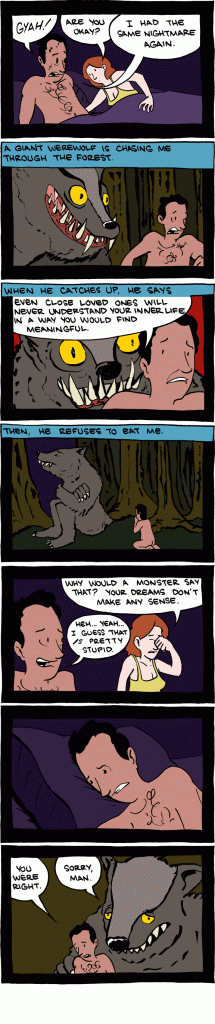
  • Lost in translation part II

    Lost in translation part II

    credit:http://www.smbc-comics.com/

  • Tracking JOY to its lair


    Last night I went to see my 10 year old daughter’s talent show. If I am honest, I was definitely not looking forward to 3 hours of little folk belting off key renditions of Annie. But, as the night wore on I found my cynicism waning and an odd sadness welling up in my heart. It became so clear to me that these courageous, bright, eager children were symbols of the ever reaching human spirit. I recognized the energy in these kids, it is the same energy I see buried beneath layers of slurry in many of the people who come seeking therapy. It is the desire to be seen, to be appreciated and loved for who they are. I too know that desire.

    Perhaps therapy is not only there to ‘know thyself’, perhaps it is also a vehicle to help one to connect to Joy…


  • The strain and strength of growing up

    The strain and strength of growing up

    I have always been a bit of a hedonist, when I was younger I used to deal with emotional difficulty by going out on the town with friends which often used to result in rather spectacular physical and emotional hangovers. In my late twenties- early thirties I began to assess the cost-benefit ratio of these little sorties and with time they have certainly all but disappeared. I have mixed feelings about this. It’s a bit like losing a crazy lover who was as mad as a hatter but had a fantastic sense of humor and an incredible mind.

    Hitting 40 has put further pressure on me to develop  healthier coping strategies, I climb, I surf, I do yoga and while I really do enjoy these pursuits, they are changing the way I deal with my inner landscape, as a result the topography of my inner-space looks different.

    No longer do I feel as free as I did when I was reckless, I used to soar like Icarus, just a bit too close to the Sun. Don’t get me wrong, I don’t miss the hangovers and admin that used to come with the lifestyle, I just miss soaring, the lightness of being.

    Increasing responsibility has come with increased gravity. Sometimes I battle to maintain a degree of carefree altitude.

    Interestingly enough I have observed that this relatively newfound stability of mind has its benefits too. Although I have been going through some pretty steep emotional terrain lately, my mind has a strength, capacity and flexibility that was certainly absent in my young ‘adulthood’. My ‘tipping point’, critical mass, whatever you want to call it is much greater than it has ever been. I can find my way to a calm inner space with less difficulty, the path is now well worn, Good friendships, slow walks, solitude, time to wonder, writing, meditating may not be dramatic ways of processing that which moves within, but in the long run, they are infinitely more effective.

    PS: There’s always a little space left for Icarus…

    Warmth

  • Growing minds

    One of the toughest parts of raising children is helping them leap the emotional and intellectual hurdles of life. As parents, we try to ease their pain when friends snub them. We console them when their fears keep them awake at night. We scold them when they behave badly, and counsel them after they forget their homework or lose something of value.

    Cute girl looking concerned, pensiveCourtesy of apdk via Flickr.

    But most of us have no idea what we are doing. The frustration from being unable to solve a child’s emotional problems or mental lapses is greater the more out-of-the-ordinary those problems seem to be. School counselors can address some issues, pediatricians others, but true experts in our children’s mental health and development are hard to find. How do we nurture our children’s brains and how do we know when they in trouble and need professional help?

    In an ordinary-looking Park Avenue office tower in New York City, an extraordinary cluster of professionals are working to understand, improve and advise the rest of us about the mental health of our children. The Child Mind Institute, founded just three years ago, is the only nonprofit organization in the U.S. dedicated solely to children’s mental health. Their mission includes diagnosing and finding better treatments for childhood psychiatric and learning disorders, gaining an improved understanding of healthy brain development, and helping families deal with issues ranging from school transitions to serious anxiety disorders and behavior problems.

    Our kids need help. According to the Institute’s website, more than 15 million children in America have psychiatric disorders and at least half of them will never receive treatment. Lots of other children, no doubt, have psychological troubles that may fall short of a disorder but that parents do not know how to handle.

    Allaying A Child’s Fears

    One of the Institute’s areas of focus is childhood anxiety, which afflicts 13 percent of kids in its assorted forms, according to Ronald Steingard, a psychopharmacologist there. Some kids have severe separation anxiety, others panic or post-traumatic stress. In pediatric obsessive compulsive disorder, children have intrusive and repetitive thoughts—say, that something will happen to mom and dad—and attempt to stamp them out with an irrational ritual they perform compulsively. They might have to wash their hands six times before bedtime or perform a triple-tap on the front door before leaving the house. In some cases, the anxieties and behaviors become so numerous and pervasive that they essentially take over a child’s life.

    cute boy looking nervousAnxiety is a problem for 13 percent of kids. Courtesy of shelbyasteward via Flickr.

    The gold standard therapy is exposure with response prevention, in which the child repeatedly confronts the objects, thoughts and situations that prompt his or her anxieties without being allowed to perform his or her rituals. Most kids receive this remedy in short weekly doses in a therapist’s office, but the Child Mind Institute also offers an intensive program in which a child spends a better part of a week, four to five laborious hours a day, trying to beat back his illness. With this approach, therapists spend time with the children in the places that elicit the troublesome responses. If a child believes that stepping on a crack will really break her mother’s back, the child and the therapist might take a walk and step on cracks and together confront the associated angst. The program has seen considerable success, leading to a 40 to 90 percent reduction in symptoms for all participants, according to its director, Jerry Bubrick. Families from London, Hong Kong and across the U.S. have come to the center to get concentrated help for their kids.

    Selective mutism is an extreme form of social anxiety in children. Kids with this problem will only speak to certain people—mom and dad, for example—and only in a certain environment, say inside their home. Everywhere else, they fail to utter a word. The cause of the condition is not defiance but extreme self-consciousness. Children want to chat with their pals at a party or answer a teacher’s question in class, but their fear muffles them.

    As one answer to this silence, Institute offers a week-long day program called Brave Buddies for children ages four through nine. The program features a mock school setting in which children practice talking in front of a group, with a counselor at their side. It includes parts of a typical day that require lots of talking such as morning meeting and field trips to parks or museums. Children earn points and prizes for each instance of “brave talking.” By the end of the week, words and whispers fill a room that had once been soundless. The vast majority of children, who were mute at the start of the week, can, by the end, go to an ice cream shop and request their favorite flavor. Children speak on their own accord three times as often as they did before.

    Parent Training

    The Institute also offers behavioral intervention for attention-deficit hyperactivity disorder and disruptive behaviors such as oppositional defiance disorder. An approach called parent-child interaction therapy (PCIT) is directed less at difficult children themselves than at teaching their parents how to deal with problematic behavior. When Steven Kurtz, who directs the ADHD and Disruptive Behavior Disorders Center, first described it to me, it sounded useful as a general parenting strategy, even if your kid is just difficult in all the normal ways. Supposedly it works best on kids ages two to seven, but it seemed to me that some of the tips could be adapted to older children as well.

    blurry small girl in doorwayCourtesy of frozenchipmunk via Flickr.

    In the formalized therapy, a parent leads her child or children in a series of tasks while a therapist watches through a one-way mirror. Though not part of the action, the therapist guides the parent by speaking instructions into a microphone that the parent receives by way of an earbud. Kurtz told me about a case in which two siblings were playing a game that involved slamming a door. Concerned that the game would result in a broken finger, the mother did what most of us would do: She told the kids that if they kept slamming the door, the game would have to stop. But the therapist had different advice. Instruct the children to practice closing the door carefully, the specialist said, advancing a positive behavior rather than trying to block a negative one.

    In this “school,” parents graduate after 14 to 17 weekly sessions. Studies show that the program leads to more compliant and less disruptive children, shifting their behavior into the typical range. Parents’ stress levels also drop dramatically. According to a 2003 study, these improvements last up to six years.

    In its effort to reach more children, the Institute is increasingly sending its tentacles into the community. According to Steingard, emerging pathology shows up primarily in two places: at school and in the pediatrician’s office. As a result, the Institute is trying to connect with both. For instance, it maintains an access line for pediatricians to call with questions about children’s mental health. “I want to see kids early on, before they even have a diagnosis,” Steingard says. In its efforts to reach into schools, Institute therapists have adapted PCIT to a classroom setting to help teachers control disruptive students. They tested the approach last year in 11 kindergarten and first grade classrooms in three New York City public schools. Preliminary results indicate that the therapy greatly improves class management. The teachers who used the techniques they learned referred fewer children to special services than did untrained educators in comparison classrooms.

    Aside from its efforts on behalf of troubled kids and the adults in their lives, the Institute offers a plethora of advice for all parents. It provides support for families in the throws of separation or divorce. Its website also suggests solutions to conundrums from school transitions to teen sex and substance abuse.

    father hand and tiny daughter handCourtesy of apdk via Flickr.

    Perusing the website, I immediately encountered three articles I found helpful. The Secret to Calm Parentinghighlighted the dangers of being overprotective of children, perhaps making them overanxious and afraid to explore or tackle challenges. InFamily Dinner: How Much Does It Matter? I learned that I won’t harm my kids irrevocably by not regularly wrapping us all around a table every mealtime as long as I practice mindful attention when i am with them (most of the time) . And in Back-to-School Dos and Don’ts, I got some good advice for transitioning my kids for the new school year. I’m lucky that my own children do not seem to have significant psychological troubles, but I still need a lot of help.